Seizure First Aid: What to Do When Someone Has a Fit in Vijayawada
You are at a bus stop in Benz Circle, at a wedding, or at home when someone suddenly falls, goes stiff and starts jerking. Most people freeze, and many reach for an old remedy they have heard about. Knowing simple seizure first aid helps you stay calm, keep the person safe and decide when to call for help. With National Epilepsy Day on 17 November, this is a good time for every family in Vijayawada to learn these steps.
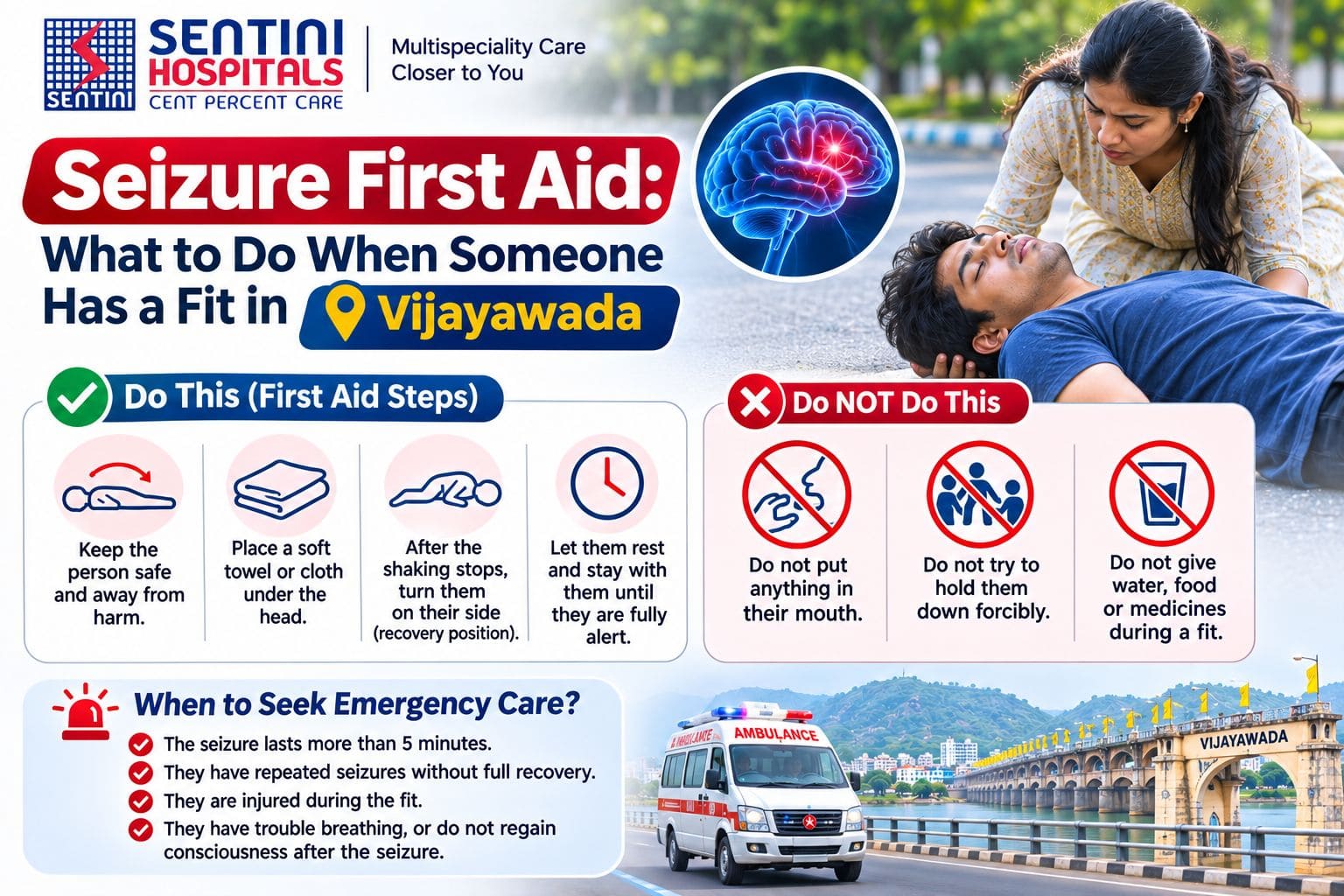
Quick answer: Stay calm and note the time. Move dangerous objects away, cushion the person's head and loosen anything tight around the neck. Do not hold them down and do not put anything in their mouth. When the jerking stops, turn them onto their side in the recovery position and stay with them until they recover. Call 108 if it is their first seizure, it lasts more than 5 minutes, they are injured, they have trouble breathing or they do not wake up fully.
Why seizure first aid matters
Epilepsy is a long-term condition of the brain that causes repeated seizures. According to the World Health Organization (WHO), around 50 million people worldwide live with epilepsy, making it one of the most common neurological conditions, and close to 80% of them live in low- and middle-income countries (WHO: Epilepsy fact sheet).
WHO also notes that up to 10% of people have a single seizure at some point in their lives, and that one seizure does not mean a person has epilepsy. Epilepsy is usually diagnosed after two or more unprovoked seizures.
Seizures can happen anywhere: on a bus, at school, at work or in a temple queue. Many of the injuries linked to seizures, such as falls, burns and drowning, can be reduced when people around know what to do.
National Epilepsy Day, 17 November
National Epilepsy Day is observed in India on 17 November to raise awareness about epilepsy, its symptoms and treatment, and to reduce stigma. WHO points out that the stigma around epilepsy is often harder to deal with than the seizures themselves, and that myths can stop people from seeking treatment.
What does a seizure look like?
Seizures happen because of a sudden burst of electrical activity in the brain. Not every seizure involves falling and shaking. The NHS lists symptoms that can include:
- The body suddenly becoming stiff or floppy
- Falling to the floor
- Jerking or twitching of the arms, legs or whole body
- Staring into space and not responding for a few seconds
- Passing urine without meaning to
- Unusual feelings such as a strange smell, tingling, or a sudden feeling of fear
- Unusual behaviour such as fidgeting, lip-smacking or wandering without awareness
Most seizures last a few seconds to a few minutes and stop on their own. Afterwards, the person may be confused, sleepy or have a headache for some time.
| Type of seizure | What you may see | What to do |
|---|---|---|
| Tonic-clonic (convulsive) | Person falls, goes stiff, then jerks; may bite tongue or pass urine | Protect the head, time it, recovery position after jerking stops |
| Absence | Brief blank stare, stops talking for a few seconds | Stay with them, reassure, note how often it happens |
| Focal (partial) | Twitching of one part of the body, or confused, repeated movements | Guide them gently away from danger, stay until they are fully aware |
| Febrile seizure (young children) | A child with high fever who becomes stiff or jerks | Keep the child safe on their side and seek medical advice the same day |
Seizure first aid: step by step
These steps are based on NHS guidance on what to do if someone has a seizure (NHS: What to do if someone has a seizure).
During the seizure
- Stay calm and check the time. Note when the seizure started; this helps you and the doctor.
- Make the area safe. Move furniture, sharp objects, hot vessels or a lit stove away. Only move the person if they are in danger, for example near a road, water or fire.
- Cushion the head with a folded cloth, bag or your hands.
- Loosen tight clothing around the neck, such as a collar, tie or dupatta.
- Do not hold them down or try to stop the movements.
- Do not put anything in their mouth, not even your fingers, a spoon or a cloth. A person cannot swallow their tongue.
After the jerking stops
- Turn them onto their side in the recovery position so saliva can drain and the airway stays open.
- Check their breathing.
- Stay with them and talk calmly until they are fully awake. They may be confused for a while.
- Do not give food, water or tablets until they are fully alert.
- Note what happened before and during the seizure. A phone video, if the family agrees, can help the doctor.
Keys, iron rods and onions do not stop a seizure. Holding a bunch of keys or an iron object in the person's hand, making them smell an onion or a shoe, or sprinkling water on their face are common beliefs, but they do not help. A seizure usually stops on its own. Focus on keeping the person safe and timing the seizure.
When to call 108
The NHS advises calling an ambulance if:
- It is the person's first seizure
- The seizure lasts more than 5 minutes, or longer than is usual for them
- The person does not regain full consciousness, or has another seizure without waking in between
- The person is seriously injured during the seizure
- The person has difficulty breathing after the seizure
Also seek emergency care if the seizure happened in water, the person is pregnant or has diabetes, or the seizure followed a head injury.
People with known epilepsy do not always need to go to hospital after a seizure. Many have a care plan from their doctor that explains what to do, including when to give emergency medicine. If you live or work with someone who has epilepsy, ask them or their family about their plan.
What happens after a first seizure?
A first seizure should always be checked by a doctor. A neurologist will usually ask detailed questions about what happened, so the description from someone who saw it is very useful. Tests may include:
- Blood tests to look for causes such as low sugar, low salt levels or infection
- EEG (electroencephalogram), which records the brain's electrical activity
- Brain imaging such as a CT scan or MRI to look for causes like a past injury, stroke or infection
Treatment and living with epilepsy
According to WHO, up to 70% of people living with epilepsy could stop having seizures with proper diagnosis and treatment, mostly with antiseizure medicines. Treatment is planned by a doctor and depends on the type of seizure, age and other health conditions.
Helpful habits for people with epilepsy include:
- Taking medicines at the same time every day and never stopping them suddenly without medical advice
- Getting enough sleep, as lack of sleep can trigger seizures in some people
- Limiting alcohol
- Avoiding swimming alone, and being careful near cooking fires, terraces and heights
- Carrying a card or wearing a bracelet that says they have epilepsy
During the cyclone and floods: Power cuts, travel problems and shifting to relief shelters can disrupt routines. If you or a family member has epilepsy, keep at least a week's supply of medicines in a waterproof bag, with a copy of the prescription.
How Sentini Hospitals can help
Sentini Hospitals, on Ring Road opposite Novotel Hotel in Vijayawada, has a Neurology department whose page lists epilepsy among the conditions its neurology team works with. The hospital's Diagnostics and Imaging department provides imaging services, and its Emergency and Critical Care department supports patients who need emergency treatment.
If you or someone in your family has had a seizure and would like to see a neurologist, call +91 9010726666 or visit our contact page. If a seizure lasts more than 5 minutes or the person does not wake up, call 108 immediately.
Frequently Asked Questions
What should you do when someone has a seizure?
Stay calm, note the time, move dangerous objects away, cushion their head and loosen tight clothing. Do not hold them down or put anything in their mouth. When the jerking stops, turn them onto their side and stay with them until they recover.
Should you put something in a person's mouth during a seizure?
No. Never put anything in their mouth, including fingers, a spoon or cloth. A person cannot swallow their tongue during a seizure, and objects can break teeth or block the airway.
When is a seizure an emergency?
Call 108 if it is the person's first seizure, it lasts more than 5 minutes, they have repeated seizures without waking, they are injured, or they have difficulty breathing afterwards.
Does holding keys or iron stop a seizure?
No. Keys, iron objects, onions or shoes do not stop seizures. Most seizures stop on their own within a few minutes. The most useful help is to keep the person safe and time the seizure.
Does one seizure mean a person has epilepsy?
Not always. WHO notes that up to 10% of people have a single seizure in their lifetime. Epilepsy is usually diagnosed after two or more unprovoked seizures. Anyone who has a first seizure should be checked by a doctor.
Can epilepsy be treated?
Yes. WHO states that up to 70% of people with epilepsy could stop having seizures with the right diagnosis and treatment, usually antiseizure medicines prescribed and monitored by a doctor.
Medical disclaimer: This article is for general health education and does not replace advice from a qualified doctor. In an emergency, call 108. Information is based on WHO and NHS guidance available on 28 October 2026.