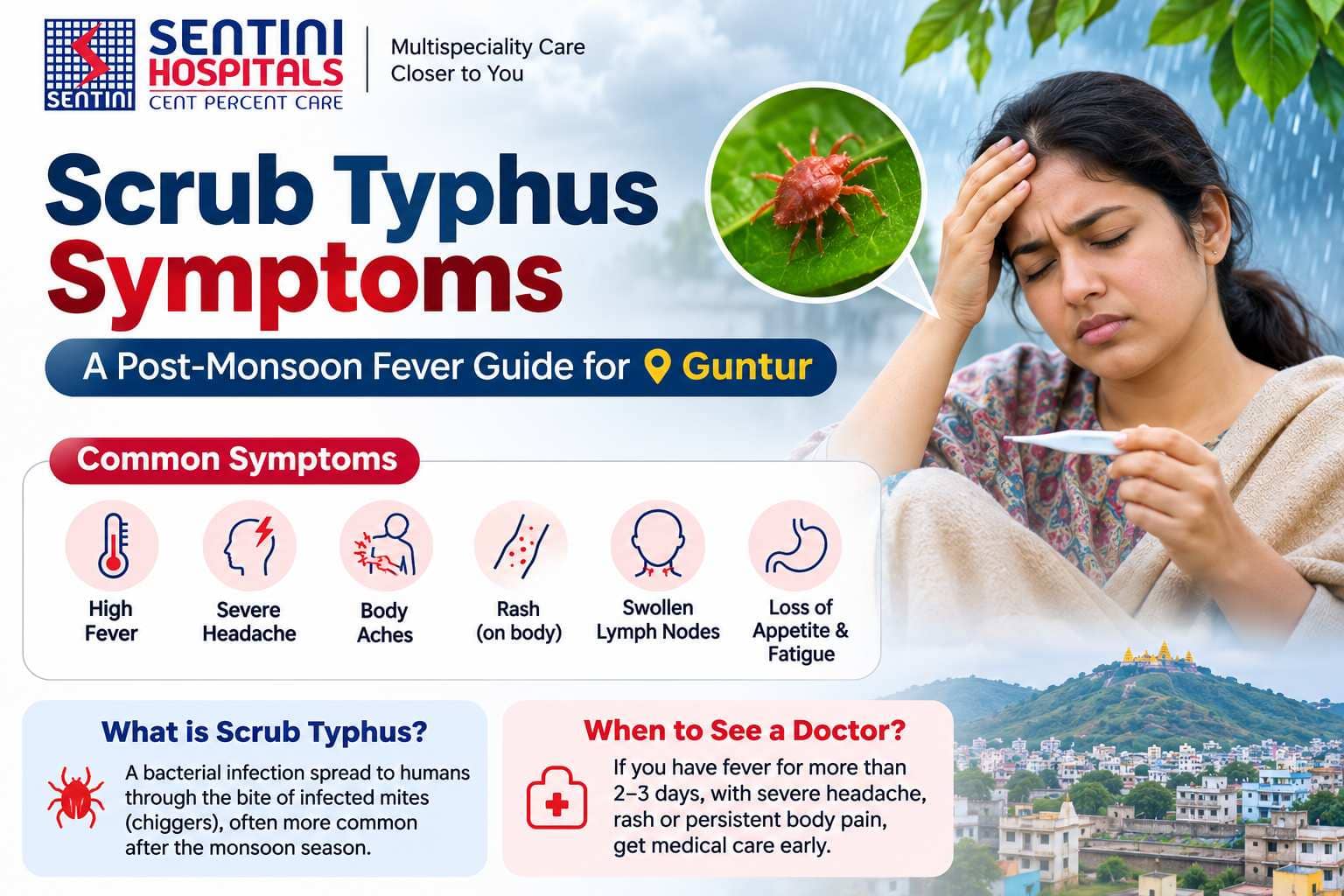
Scrub Typhus Symptoms: A Post-Monsoon Fever Guide for Guntur
The paddy harvest is close, the fields are still wet after Cyclone Arnab, and many families in Guntur district are out in the fields, along canal bunds and in grassy backyards. This is also the season when a fever called scrub typhus rises in Andhra Pradesh. Knowing the scrub typhus symptoms, especially a small black scab called an eschar, helps people seek care early, when the infection responds well to treatment.
Quick answer: Scrub typhus is a bacterial infection spread by the bite of infected chiggers (larval mites) that live in grass, scrub and farm fields. Symptoms usually start 6 to 21 days after the bite and include fever with chills, severe headache, body ache and swollen lymph nodes. Many people have a small black scab that usually does not hurt (an eschar) at the bite site. It does not spread from person to person. It is treated with antibiotics prescribed by a doctor, so see a doctor early for any fever lasting more than two to three days after outdoor work.
Scrub typhus in Guntur: what every family should know
What is scrub typhus?
Scrub typhus is caused by the bacterium Orientia tsutsugamushi. It is passed to people through the bite of infected chiggers, the tiny larval stage of trombiculid mites. Chiggers are so small that most people never notice the bite.
According to the National Centre for Disease Control (NCDC), chiggers are found in rice fields, grassy fields, scrub, forest clearings and riverbanks. Farmers and agricultural workers are among the people at highest risk, and cases in India show a seasonal peak after the monsoon (NCDC: Scrub typhus guide).

Image: Michael Wunderli via Wikimedia Commons (CC BY 2.0)
Why scrub typhus matters in Andhra Pradesh this season
Scrub typhus is reported every year in Andhra Pradesh. The state recorded 941 cases in 2026 as of 30 August, according to a Deccan Chronicle report on the state's disease surveillance during the rains (Deccan Chronicle, 13-09-2026). The same report noted 1,566 confirmed cases in 2025 and 1,689 in 2024.
Guntur has seen cases too. In December 2025, the Government General Hospital in Guntur reported 26 cases over 38 days, and doctors there described the eschar as a key sign (The New Indian Express, 09-12-2025).
After Cyclone Arnab, the state health department has said it is monitoring fever cases and holding medical camps in affected areas (Deccan Chronicle, 30-10-2026). Wet fields, overgrown grass and clean-up work around homes can all bring people into closer contact with chiggers in the weeks ahead.

Image: Suresh Babunair via Wikimedia Commons (CC BY 3.0)
Scrub typhus symptoms to watch for
Symptoms usually appear 6 to 21 days after the chigger bite, most often around 10 to 12 days. NCDC lists the following:
- Fever that starts suddenly, often with chills
- Severe headache
- Body ache and muscle pain
- An eschar: a small black scab, like a cigarette burn, at the bite site; it usually does not hurt
- Swollen, tender lymph nodes, often near the eschar
- A rash on the trunk, which may appear between the third and eighth day of fever
- Cough, red eyes, nausea or loss of appetite in some people
How to look for an eschar
The eschar is one of the most useful clues for doctors, but it is easy to miss because it does not hurt or itch much. NCDC notes that it is seen in roughly half or more of patients.
Chiggers tend to bite where clothing is tight or skin is folded and moist. Check these areas carefully if someone has a fever after field or garden work:
- Armpits
- Groin and genital area
- Under the waistband, belt line and under the breasts
- Chest and abdomen
- Behind the knees and around the ankles
- Behind the ears and along the hairline
Tell the doctor about any small black scab, even if it looks harmless.
Warning signs: when to go to hospital immediately
If scrub typhus is not treated, complications can develop, usually in the second week of illness. NCDC describes complications such as pneumonia, inflammation of the brain and its coverings (meningoencephalitis), heart inflammation, bleeding problems and kidney failure.
Go to the nearest emergency department or call 108 if a person with fever has: breathlessness or fast breathing; confusion, drowsiness, a seizure or neck stiffness; very little urine; yellow eyes; bleeding from gums or nose, or dark stools; chest pain or a racing heart; or a very low blood pressure feeling such as fainting.
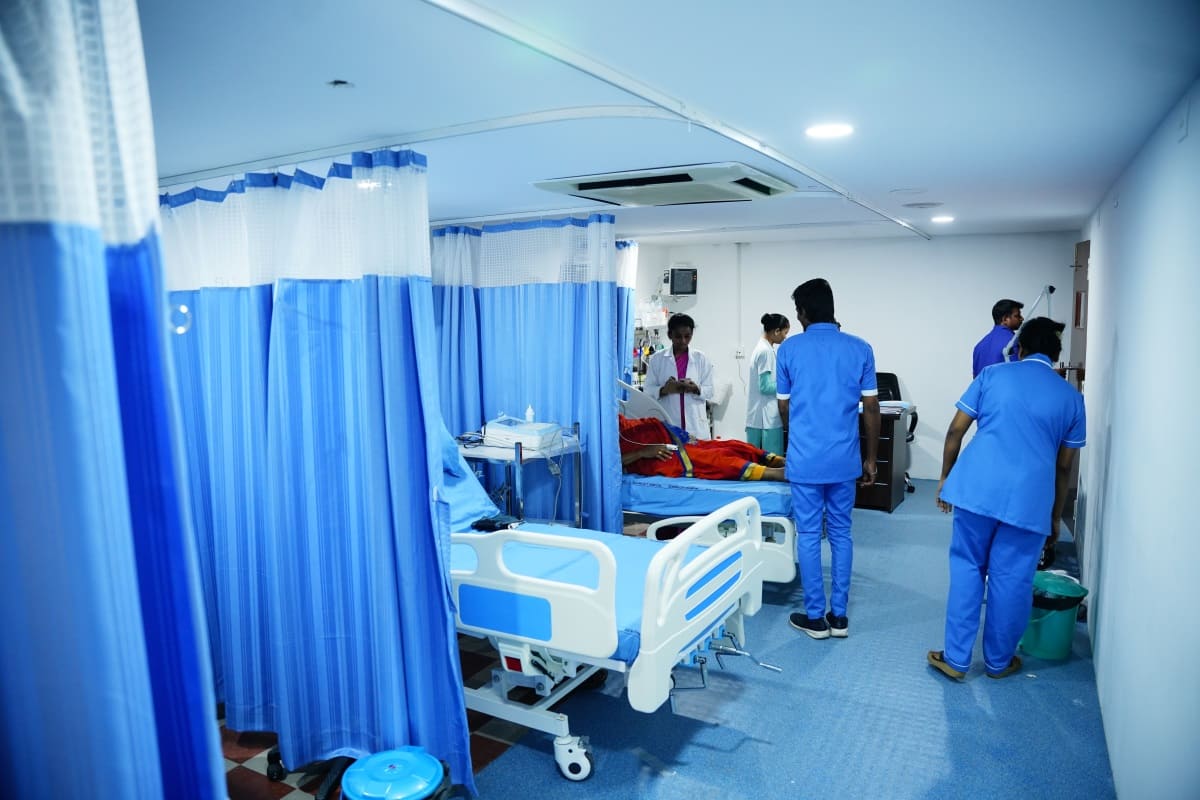
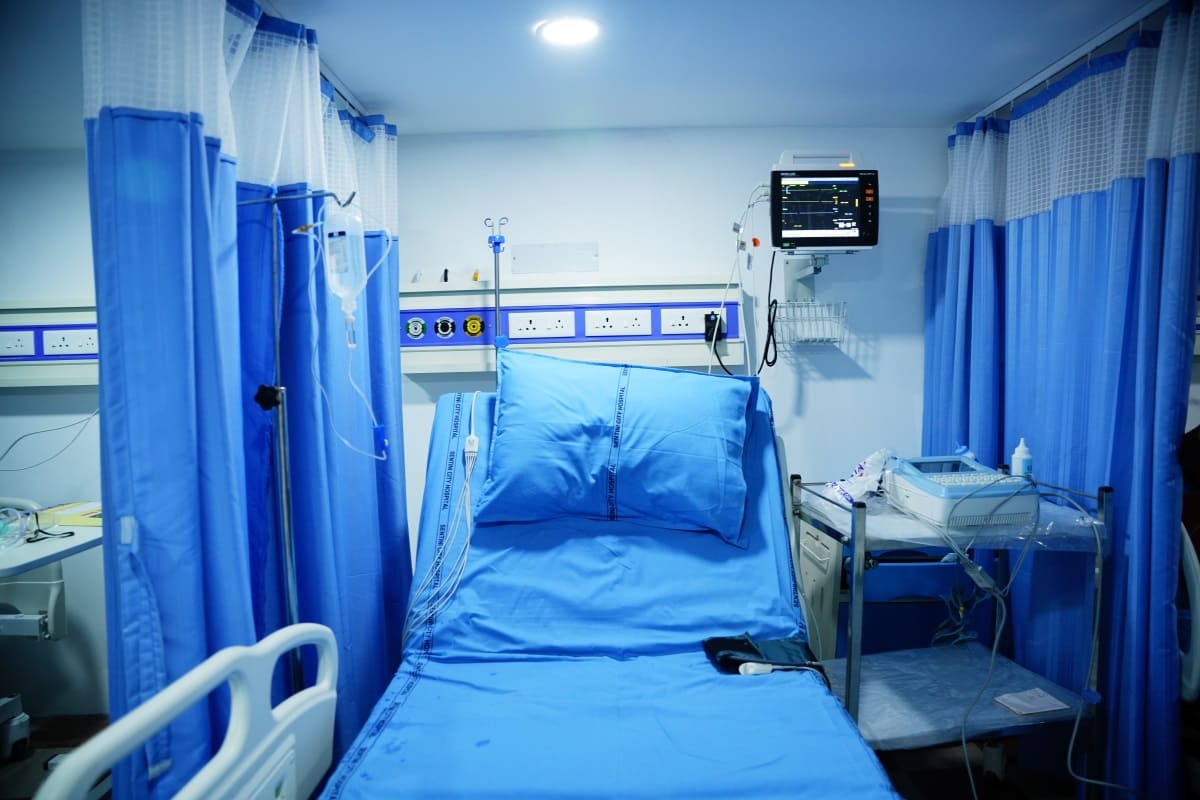
Some patients need intensive care. The critical care unit at Sentini Hospitals lists support such as mechanical ventilation, renal replacement therapy (dialysis) and ECMO for critically ill patients.
Scrub typhus, dengue, malaria or leptospirosis?
After the monsoon, many fevers look alike at first. A doctor will decide which tests are needed. This table shows some common features, but it is not a tool for self-diagnosis:
| Illness | How it spreads | Clues the doctor may look for |
|---|---|---|
| Scrub typhus | Bite of infected chiggers in grass, scrub and fields | Eschar, swollen lymph nodes, history of field or outdoor work |
| Dengue | Bite of Aedes mosquitoes, often near homes | Pain behind the eyes, joint and muscle pain, low platelets |
| Malaria | Bite of Anopheles mosquitoes | Fever with shivering that may come in cycles |
| Leptospirosis | Contact with water or soil contaminated by animal urine | Calf muscle pain, red eyes, contact with flood water |
| Typhoid | Contaminated food or water | Gradually rising fever, abdominal symptoms |
How is scrub typhus diagnosed?
Diagnosis starts with a careful history and examination, including a full skin check for an eschar. Doctors may then order blood tests. NCDC notes that PCR-based tests are useful in the first week of illness, and the IgM ELISA blood test becomes the preferred test from about the second week. Other tests, such as a complete blood count, liver and kidney function tests and a chest X-ray, help the doctor see whether any organs are affected.
The pathology department at Sentini Hospitals provides laboratory services including microbiology, immunology and haematology. Ask the hospital which specific fever tests are available.
How is scrub typhus treated?
Scrub typhus is treated with antibiotics, most commonly doxycycline or azithromycin. Azithromycin is often used in pregnancy and for young children. The doctor decides the medicine, dose and duration based on the patient's age, condition and test results.
NCDC stresses that early recognition and prompt treatment with doxycycline or azithromycin are crucial and can prevent severe complications. That is why early care matters.
Please do not:
- Take leftover antibiotics or buy antibiotics without a prescription
- Rely only on paracetamol for a fever that lasts more than two to three days
- Delay a hospital visit if any warning sign appears
How to prevent scrub typhus
There is no vaccine for scrub typhus, so prevention is about avoiding chigger bites. NCDC advises the following steps:
- Cover up with long sleeves and full-length trousers when working in fields, scrub or grass.
- Tuck trousers into socks or boots, and wear footwear in the fields.
- Use insect repellents containing DEET on exposed skin, as directed on the label. Clothing treated with permethrin can also help.
- Clear tall grass and bushes around your home, cattle shed and backyard.
- Avoid sitting or lying directly on grass; use a mat or sheet.
- Bathe and change clothes after outdoor work, and wash work clothes in hot water and dry them well.
- Check your skin for any small black scab in the days after field work.
A note for farm families in Guntur district
From Tenali and Ponnur to Prathipadu and Mangalagiri, paddy and other crops keep many families in the fields from dawn to dusk. Harvest helpers, cattle grazers, people cutting grass for fodder and workers clearing canals after the cyclone all face higher exposure.
If anyone in your household develops a fever one to three weeks after such work, mention the outdoor work to the doctor. This simple detail can help the doctor think of scrub typhus early.
Frequently Asked Questions
What are the first symptoms of scrub typhus?
The first scrub typhus symptoms are usually sudden fever with chills, severe headache and body ache. Many people also have a small black scab called an eschar where the chigger bit them, along with swollen lymph nodes nearby. A rash may follow a few days later.
Does scrub typhus spread from person to person?
No. Scrub typhus spreads only through the bite of infected chiggers (larval mites). It does not spread by touch, coughing, sharing food or caring for a sick person.
How long after a chigger bite do symptoms start?
Symptoms usually start 6 to 21 days after the bite, most often around 10 to 12 days, according to NCDC. Mention any field, garden or forest exposure in the past three weeks to your doctor.
Can scrub typhus be treated?
Yes. Scrub typhus is treated with antibiotics such as doxycycline or azithromycin, prescribed by a doctor. Treatment works well when started early. Delayed treatment raises the risk of complications affecting the lungs, brain, heart or kidneys.
Is there a vaccine for scrub typhus?
No vaccine is available. Prevention depends on avoiding chigger bites: wear long sleeves and trousers, tuck trousers into socks, use repellents, clear grass around the home and bathe after outdoor work.
Fever after field work? Speak to Sentini Hospitals
If you or a family member in Guntur, Mangalagiri, Tadepalli or Vijayawada has a fever after working in fields or clearing grass, see a doctor early rather than waiting. To book a consultation or ask about tests at Sentini Hospitals, call +91 9010726666 or use the contact page. In an emergency, call 108.
Disclaimer: This article is for general health education and does not replace a consultation with a qualified doctor. Do not take antibiotics without a prescription. Case figures are from the cited news reports and NCDC guidance, accessed on 31 October 2026.