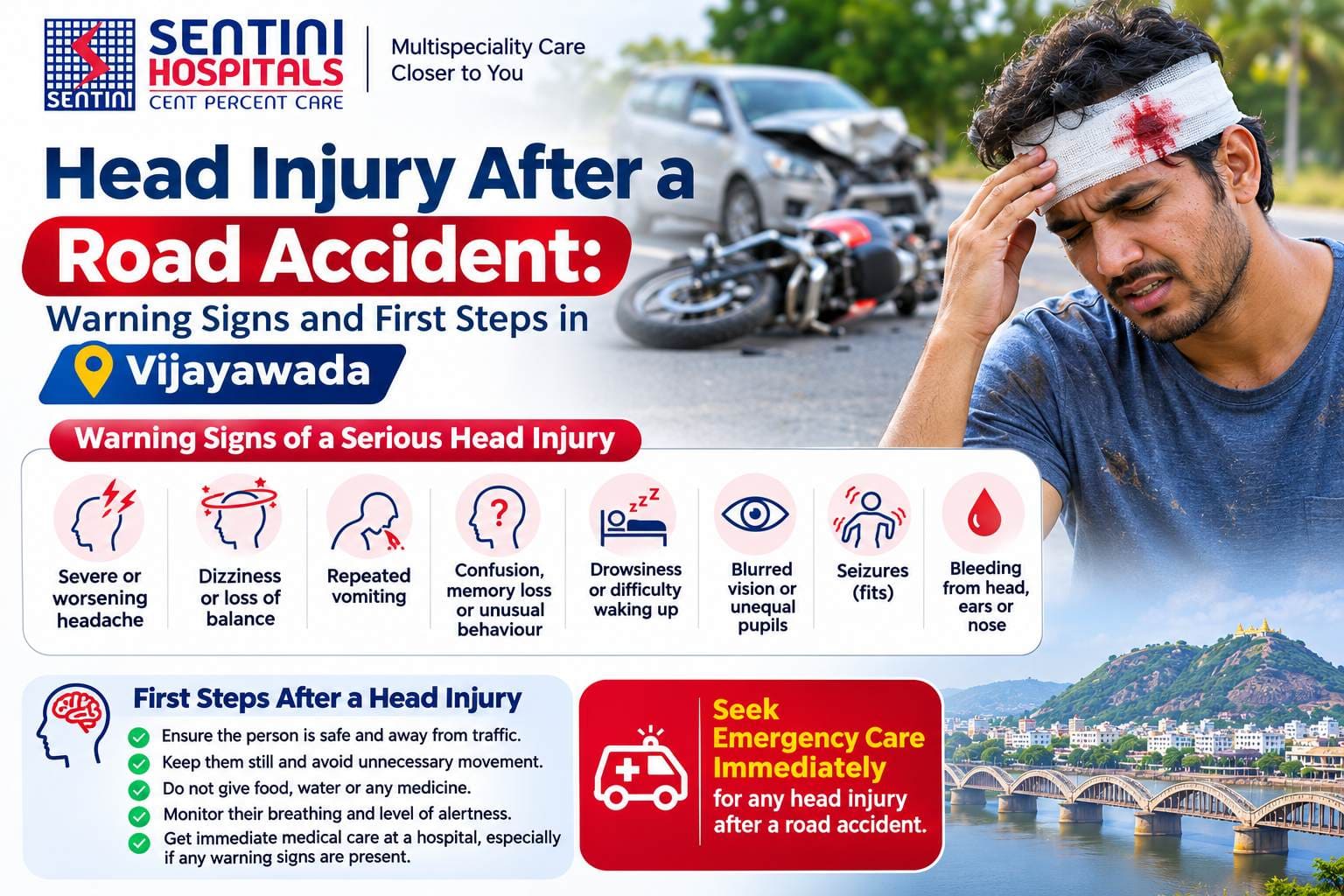
Head Injury After a Road Accident: Warning Signs and First Steps in Vijayawada
A two-wheeler skids on a wet road near Benz Circle. The rider gets up, says "I'm fine" and rides home. A few hours later he has a headache that keeps getting worse and starts vomiting. Situations like this are why knowing the head injury warning signs matters for every family. Some brain injuries do not show their danger straight away. With festival travel around Diwali (8 November) and the World Day of Remembrance for Road Traffic Victims on 15 November 2026, this guide explains what to watch for after a road accident and what to do in the first hour.
Quick answer: After any road accident involving a blow to the head, call 108 or go to an emergency department straight away if the person was knocked out, has a seizure, cannot stay awake, vomits, has a severe or worsening headache, has blood or clear fluid from the ears or nose, has new weakness, numbness, slurred speech or trouble walking, has vision problems, or behaves unusually. Do not let them drive. A high-speed impact such as a road accident needs a medical check even if the person feels well.
Head injuries on our roads: what to watch for and what to do
Why road accidents and head injuries are a concern
Road traffic injuries are a major cause of death and disability worldwide. According to the World Health Organization (WHO), about 1.16 million people die on the world's roads each year, and road traffic injuries are the most common cause of death for children and young people aged 5 to 29 (WHO: Road traffic injuries fact sheet).
In Andhra Pradesh, the Ministry of Road Transport and Highways (MoRTH) report Road Accidents in India 2023 recorded 19,949 road accidents in the state, with 8,137 deaths and 20,409 people injured. Vijayawada city alone recorded 1,522 accidents, 373 deaths and 1,416 injuries that year, as summarised by the Deccan Chronicle (MoRTH: Road Accidents in India 2023).
Head injuries are among the most serious injuries for riders and pillion passengers of two-wheelers, and for pedestrians and cyclists hit by vehicles.
Types of head injury
Not every head injury is the same. Doctors broadly describe:
- Minor head injury or concussion: a temporary change in how the brain works after a blow, causing headache, dizziness, confusion or memory gaps. Most people recover with rest, but they need watching.
- Skull fracture: a break in the bone of the skull, which may be visible or hidden.
- Bleeding inside the skull: blood can collect between the skull and the brain or within the brain. Symptoms may develop over hours, which is why the first day after an injury matters.
- Diffuse brain injury: widespread damage from the brain moving inside the skull during a sudden stop, common in high-speed crashes.
You cannot tell which type it is just by looking. Only a doctor, often with a CT scan, can decide.
Head injury warning signs that need emergency care
The NHS lists the following signs that need emergency care after a head injury (NHS: Head injury and concussion). In India, call 108 or go to the nearest emergency department if a person:
- Was knocked out and has not woken up, or cannot stay awake
- Has a seizure (fit)
- Has problems with vision or hearing
- Has a black eye without a direct hit to the eye
- Has clear fluid coming from the ears or nose
- Has bleeding from the ears or bruising behind the ears
- Has numbness or weakness in part of the body
- Has problems walking, with balance, understanding, speaking or writing
- Was hit at high speed, such as in a road accident, or fell from a height of more than 1 metre or more than 5 stairs
- Has a visible dent in the head or an object stuck in it
- Shows changes in behaviour, such as being unusually irritable or confused
Signs that still need a same-day medical check
The NHS also advises getting medical help urgently if, after a head injury, a person:
- Has been vomiting
- Has a headache that does not go away with simple painkillers
- Has memory problems about the event
- Feels dizzy or very tired
- Takes blood-thinning medicines, or has had brain surgery before
- Had been drinking alcohol or taking drugs at the time of injury
Elderly people and young children need extra care, because symptoms can be harder to notice.
| Situation after a head injury | What to do |
|---|---|
| Unconscious, seizure, weakness, fluid or blood from ears or nose | Call 108 now; do not move the person unless they are in danger |
| Vomiting, worsening headache, confusion, drowsiness | Go to an emergency department straight away; do not drive yourself |
| High-speed road accident, even if the person feels well | Get a medical check the same day |
| Mild bump, no warning signs, person fully alert | Rest at home with an adult nearby for 24 hours; go to hospital if any warning sign appears |
First steps at the scene of a road accident
If you are the first person to reach an accident, your calm actions can help. Keep yourself safe first.
- Make the scene safe. Switch on hazard lights, warn oncoming traffic and keep a safe distance from moving vehicles.
- Call 108 and give the exact location, such as a landmark, junction or kilometre stone.
- Do not move the injured person unless there is immediate danger, such as fire or traffic. A head injury can come with a neck or spine injury.
- Keep the head and neck still. If you must move them, support the head and neck in line with the body.
- Leave a full-face helmet on unless it is stopping the person from breathing. Removing it wrongly can harm the neck.
- Check breathing. If the person is unconscious but breathing and you have to leave them, or they start vomiting, turn them gently onto their side while keeping the head and neck in line.
- Control bleeding with gentle pressure using a clean cloth. Do not press hard on a wound where the skull may be broken.
- Do not give food, water or alcohol.
- Note what happened, such as the time, whether the person was knocked out and for how long, so you can tell the ambulance team and doctors.
Caring for a minor head injury at home
If a doctor has checked the person, or the injury was mild with no warning signs, the NHS advises:
- Hold an ice pack (or a bag of frozen peas wrapped in a cloth) on the swelling for short periods.
- Rest and avoid stress. Simple painkillers such as paracetamol can be used, as advised.
- Make sure an adult stays with them for at least 24 hours.
- Do not drive or ride until you have fully recovered.
- Avoid alcohol and sleeping pills.
- Avoid contact sports for at least 3 weeks.
Go back to hospital straight away if any warning sign appears, even days later.
What happens in hospital?
In the emergency department, doctors check breathing, blood pressure and level of consciousness, and look for other injuries. A CT scan of the head is commonly used to look for bleeding or fractures. Some people are kept under observation; others may need surgery to relieve pressure or remove a blood clot, and some need intensive care.
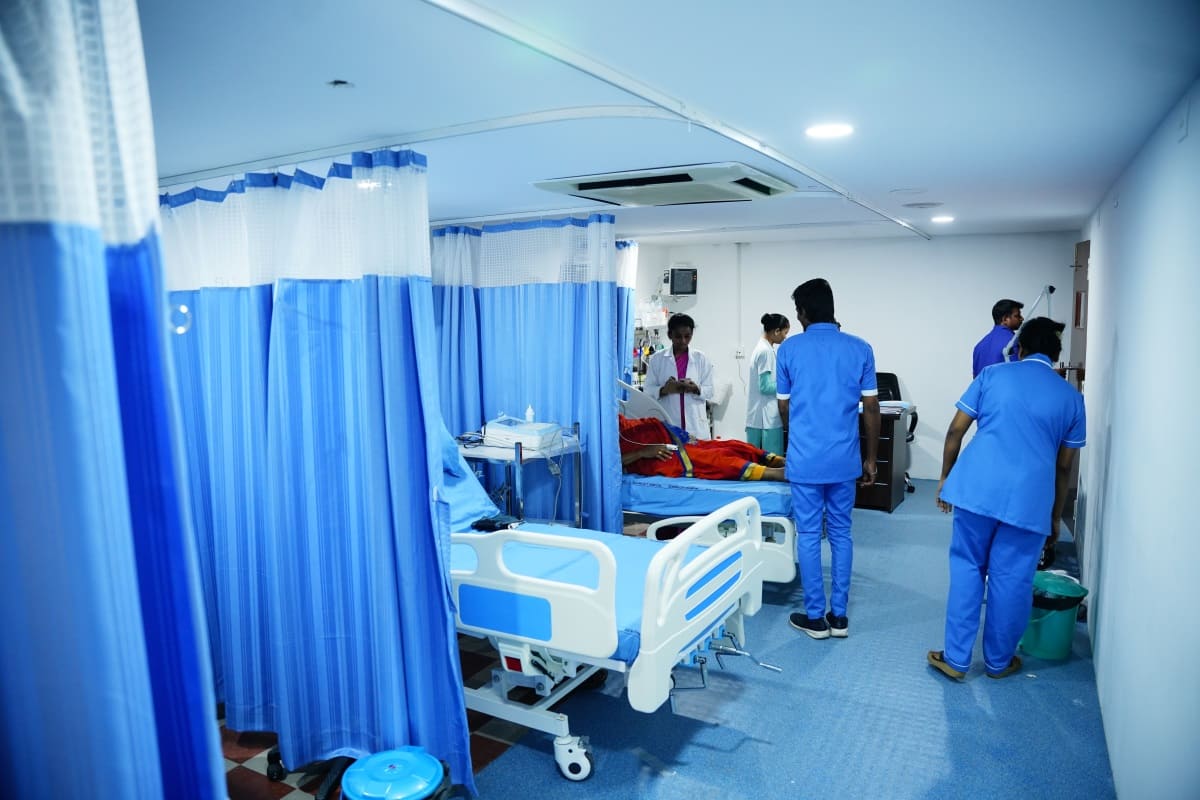
Sentini Hospitals describes a trauma care service with a trauma team available 24/7 for injuries such as road traffic accidents and head and spinal injuries, and a neurosurgery department that treats head and spine injuries. CT and other scans are listed on the diagnostics and imaging page.
Preventing head injuries on the road
Many serious head injuries can be prevented. According to WHO:
- Wearing a helmet correctly can reduce the risk of death in a motorcycle crash by more than six times and the risk of brain injury by up to 74%.
- Wearing a seat belt can reduce the risk of death among drivers and front-seat passengers by up to 50%.
Yet helmet use remains low. The same Deccan Chronicle summary of the MoRTH 2023 report for Andhra Pradesh noted helmet rule violations by 74% of two-wheeler riders in urban areas and 78% in rural areas, rising to 98% and 99% among pillion riders. Simple habits make a difference:
- Helmet for rider and pillion, every trip, however short, with the chin strap fastened
- Seat belts for everyone in a car, including the back seat
- Children in the back, in suitable child seats where possible
- No drinking and driving, and no phone use while riding or driving
- Slow down on wet roads, flyovers and highways such as the Vijayawada–Guntur and Vijayawada–Machilipatnam stretches
- Rest on long festival drives and avoid driving when sleepy
Frequently Asked Questions
What are the warning signs of a serious head injury?
The main head injury warning signs are being knocked out, a seizure, repeated vomiting, a severe or worsening headache, drowsiness, confusion, blood or clear fluid from the ears or nose, weakness or numbness, slurred speech, trouble walking and vision problems. Call 108 if any of these appear.
Can symptoms of a head injury appear hours after an accident?
Yes. Bleeding inside the skull can build up slowly, so symptoms such as headache, vomiting or drowsiness may appear hours or even days later. This is why an adult should stay with the person for at least 24 hours and why high-speed accidents need a medical check.
Should I remove the helmet of an injured rider?
Generally, no. Leave a full-face helmet on unless it is stopping the person from breathing, and wait for trained help. Removing a helmet without supporting the neck can worsen a spine injury.
Is it safe to sleep after a head injury?
After a minor head injury that a doctor has checked, rest is helpful. An adult should stay with the person and check that they wake normally. If they are hard to wake, confused or vomiting, call 108 or go to an emergency department.
When can a person ride or drive again after a head injury?
The NHS advises not driving until you have fully recovered from a head injury. Ask your doctor when it is safe to ride or drive again, especially if you were knocked out or needed hospital care.
Contact Sentini Hospitals
If someone in Vijayawada, Gannavaram, Guntur or nearby has had a road accident or a blow to the head, do not wait for symptoms to settle on their own. In an emergency, call 108. To reach Sentini Hospitals on Ring Road, Vijayawada, call +91 9010726666 or use the contact page.
Disclaimer: This article is for general health education and does not replace emergency care or a consultation with a qualified doctor. Statistics are from the cited WHO and MoRTH sources and guidance is based on NHS advice, accessed on 31 October 2026.